
No Plan, Just Play! Why Kids Need Time to Lead
Share
When was the last time your child played without a plan, a lesson, or an adult telling them what to do?
Maybe they turned a cardboard box into a rocket ship, built a crooked tower, or invented a game with rules that changed every five minutes.
It might have looked like ordinary fun. But something important was happening: your child was making decisions, experimenting with ideas, and discovering what they could do.
New research offers another reason to protect these wonderfully unstructured moments.
What a 2026 Study Discovered
In a 2026 study published in the Journal of Experimental Child Psychology, researchers examined the effects of regular free play on 125 participating elementary-school children, ages 5–12, at an urban school.
Children were assigned to different schedules involving 45 minutes of free play each week for 12 weeks. Unlike a structured lesson or organized activity, these sessions allowed children to direct their own play.
The researchers reported improvements in children's positive emotions and prosocial behavior, such as behaviors that support positive interactions with others, during the play intervention. They also observed changes in brain activity associated with watching actions.
The findings are encouraging, but they deserve careful interpretation. This was a study at one school, not proof that free play produces identical benefits for every child. The brain findings do not establish a specific neurological mechanism, and the results should not be interpreted as a prescription for exactly 45 minutes of play.
Still, the research adds to an important message: children benefit from opportunities to play without adults controlling every moment.
Read the original peer-reviewed study.
Why Being in Charge of Play Matters
Think about everything a child might do while building an imaginary spaceship.
They decide where the doors go. They solve the problem of a collapsing cardboard wall. They negotiate who gets to be captain. When their first idea doesn't work, they invent another.
These experiences create opportunities to practice creativity, communication, flexibility, and problem-solving.
The American Academy of Pediatrics has long emphasized the importance of play in children's development, including its role in relationships, emotional regulation, language, and learning.
And while adult-guided activities have their place, children also need opportunities to follow their own curiosity.
Try the 20-Minute No-Plan Play Break
Here's an easy activity for families with children ages 3–8. Twenty minutes is simply a manageable starting point for home, not a research-established requirement.
First, gather a few ordinary objects. Try cardboard boxes, blocks, paper, washable crayons, fabric scraps, or other age-appropriate materials.
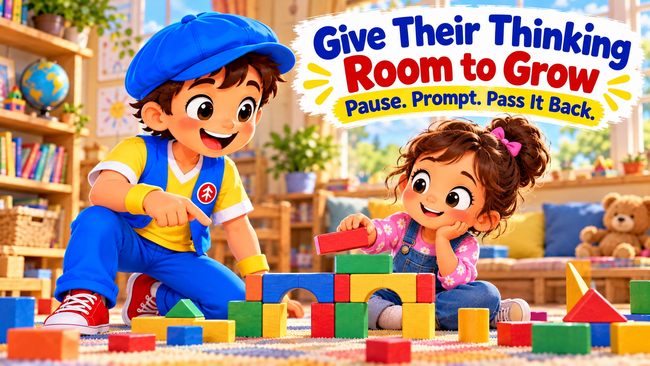
Next, let your child decide. Instead of announcing, "We're building a castle," ask, "What could we make with these?"
Then, follow their lead. If your child says the couch is a mountain and you're a lost explorer, congratulations! You're now a lost explorer.
Finally, resist the urge to improve everything. A crooked bridge doesn't necessarily need fixing. A pretend restaurant doesn't need realistic prices. And a spaceship certainly doesn't need an instruction manual.
Stay nearby, supervise appropriately, and help when needed. The goal isn't to withdraw from your child. It's to give them room to make choices.
What If Your Child Says, "I'm Bored"?
You don't have to produce an instant entertainment solution.
Offer a little encouragement: "I wonder what you could invent with those boxes."
Some children need help getting started, especially when they're tired, frustrated, or unfamiliar with independent play. You can begin together, then gradually let them take over.
And remember, free play doesn't have to happen indoors. A backyard, playground, or patch of grass can become an imaginary jungle, a science expedition, or a treasure hunt.
Sometimes the Best Plan Is No Plan
Not every childhood moment needs a measurable learning outcome.
Children need stories, songs, movement, conversations, and opportunities to practice new skills. But they also need time when nobody has decided in advance what the finished product should look like.
So the next time your child starts inventing something wonderfully ridiculous, consider joining the adventure without taking charge.
Sometimes the most useful thing a parent can say is, "What happens next?"
Sources & Further Reading
Casey and colleagues (2026). Free play's effect on elementary students' neural activity, affect, and behavior: A randomized crossover study. Journal of Experimental Child Psychology.
American Academy of Pediatrics. The Power of Play: A Pediatric Role in Enhancing Development in Young Children. Pediatrics. Reaffirmed January 2025.
HealthyChildren.org: The Power of Play — How Fun and Games Help Children Thrive. Practical guidance for families.