Parents are surrounded by messages about helping children “get ahead.” The reassuring news is that supporting a growing mind does not require expensive toys, elaborate lessons, or turning the kitchen table into a classroom.
A newly published meta-analysis suggests that ordinary activities—including reading, talking, counting, and playing together—are modestly associated with children’s development. The most useful takeaway is wonderfully manageable: small, responsive moments can matter.
What the new research found
The 2026 preregistered systematic review and meta-analysis combined 354 results from 128 studies, representing approximately 442,749 children across 60 countries. Researchers examined “caregiver cognitive stimulation,” a broad category that included shared reading, number games, conversation, and play-based activities during the first six years of life.
Across cognitive, psychosocial, and physical-development outcomes, the researchers found small, positive associations. Associations were somewhat stronger among children younger than four.
That wording matters. Most of the included evidence was observational, so this study does not prove that adding a particular game will directly cause a particular developmental gain. Families’ circumstances, children’s temperaments, schooling, health, and many other factors shape development. The findings do, however, reinforce a larger body of evidence suggesting that warm, engaging interaction is a worthwhile part of childhood.
Try the “notice, name, nudge” approach
You do not need a lesson plan. Start with whatever has caught your child’s attention:
Notice: Follow your child’s interest. Maybe they are arranging toy animals, watching a squirrel, tapping a spoon, or studying a picture.
Name: Add a little language. “You put the tiny elephant behind the big one.” “That squirrel jumped a long way.” “Your spoon made a bright, ringing sound.”
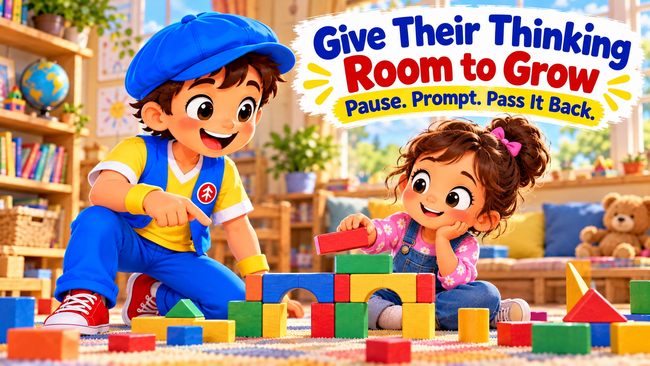
Nudge: Offer one playful invitation. “How many animals are standing?” “What do you think the squirrel will do next?” “Can we copy that rhythm?” Then pause and let your child return the idea.
This back-and-forth rhythm resembles what the Center on the Developing Child at Harvard University calls “serve and return”: a child shows interest, and a caring adult responds with attention, words, or another action.
Four easy places to begin
During a story: Ask what a character might be feeling or what could happen next. Let your child interrupt, wonder, and retell.
While cleaning up: Sort objects by size, shape, color, or purpose. Count how many are left and compare which group has more.
On a walk: Hunt for patterns, letters, sounds, shapes, or signs of seasonal change.
With music: Clap a short rhythm and invite your child to echo it. Change the speed, invent silly lyrics, or take turns leading.
Keep it light. If your child changes the subject, changes the rules, or wanders away, the activity has not failed. Young children learn through curiosity, repetition, movement, and relationships—not through perfect performances.
The Good News for Parents
You do not have to fill every minute with enrichment. Choose one ordinary moment, give your child your attention, and add a question, a word, a count, or a beat. Connection is not separate from learning; it is one of the places learning begins.
Sources & Further Reading
Hatch et al. (2026): Systematic review and meta-analysis of caregiver cognitive stimulation and child development
Center on the Developing Child at Harvard University: Serve and Return
American Academy of Pediatrics: The Power of Play
NAEYC: Building Vocabulary Through Conversation, Reading, and Singing